

Pain Relief Gel vs Spray: Which Is Better in 2026?
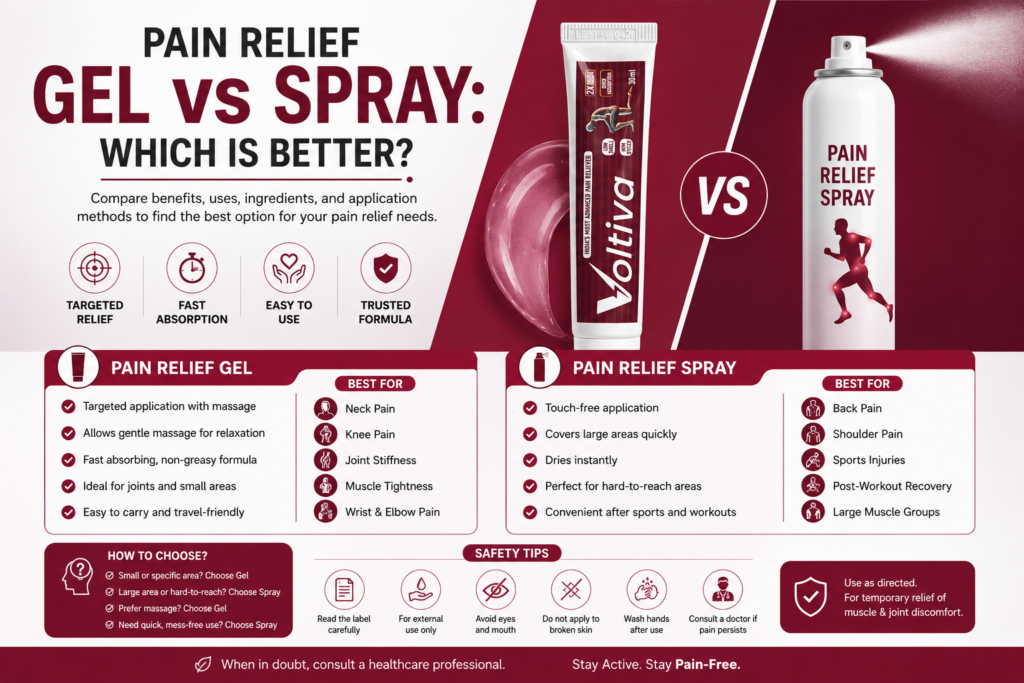
Pain Relief Gel vs Spray: Which Is Better? Muscle pain, joint stiffness, sports injuries, and everyday body aches are common problems that can affect people of all ages. Whether you’re an office worker dealing with neck pain, an athlete recovering after exercise, or someone managing occasional back pain, topical pain relief products can be a convenient option. When choosing between a pain relief gel vs spray, many people wonder which works better. The answer isn’t the same for everyone. The right choice depends on the type of pain, the area being treated, your lifestyle, and your personal preference. In this guide, we’ll compare pain relief gels and sprays, explain their differences, highlight their advantages and disadvantages, and help you decide which option best suits your needs. What Are Topical Pain Relief Products? Topical pain relief products are applied directly to the skin over the affected area. Unlike oral medications, these products are intended for localized application and are commonly used for temporary relief from muscle and joint discomfort. The most popular forms include: Each has its own advantages depending on how and where it is used. Pain Relief Gel vs Spray: Key Differences Feature Pain Relief Gel Pain Relief Spray Application Applied with hands Sprayed directly Massage Yes No Touch-Free No Yes Large Area Coverage Good Excellent Precision Excellent Good Drying Time Fast Very Fast Travel Friendly Yes Yes Suitable for Hard-to-Reach Areas Moderate Excellent What Is a Pain Relief Gel? A pain relief gel is a topical formulation that is gently massaged into the skin over the affected area. Many gels are lightweight, absorb quickly, and leave little to no greasy residue. People often choose gels because they allow gentle massage during application, which some find comforting for muscle tension and stiffness. Best For Benefits of Pain Relief Gel Targeted Application A gel allows precise application to the exact area of discomfort. Massage During Use Many people prefer applying a gel because gentle massage may help relax tight muscles. Fast Absorption Modern gels are designed to absorb quickly without leaving sticky residue. Easy to Carry Most gels come in compact tubes that fit easily into handbags, gym bags, or travel kits. For example, products such as Voltiva Pain Relief Gel are designed with a fast-absorbing, non-greasy formula for convenient topical application as part of a pain management routine. What Is a Pain Relief Spray? A pain relief spray is applied directly onto the affected area without touching the skin. This makes it especially useful for larger body areas or places that are difficult to reach. Sprays usually dry quickly and are convenient for quick application during travel or after physical activity. Best For Benefits of Pain Relief Spray Touch-Free Application Ideal if touching the painful area is uncomfortable. Covers Larger Areas Suitable for broad muscle groups like the back, thighs, or calves. Quick to Apply Simply spray the affected area according to the product instructions. Convenient After Exercise Many athletes prefer sprays for quick post-workout application. Pain Relief Gel vs Spray: Which Works Faster? Both gels and sprays are designed for topical application, and there is no universal answer as to which works faster. The experience can vary depending on: Instead of focusing only on speed, choose a product that suits the location and nature of your discomfort. Which Is Better for Different Types of Pain? Type of Pain Better Choice Neck Pain Gel Shoulder Pain Gel or Spray Back Pain Spray Knee Pain Gel Elbow Pain Gel Wrist Pain Gel Sports Injuries Spray Post-Workout Recovery Spray Muscle Tightness Gel Joint Stiffness Gel Pain Relief Gel vs Spray: Pros and Cons Pain Relief Gel Pros Cons Pain Relief Spray Pros Cons How to Choose Between a Gel and a Spray Ask yourself these questions: Where is the pain located? If it’s a small, localized area such as the knee or wrist, a gel may provide more precise application. Do you want to massage the area? Choose a gel if you prefer to massage while applying. Is the painful area difficult to reach? A spray is often more convenient for the upper or lower back. Are you often on the move? Both options are portable, but sprays offer quick, touch-free application after workouts or while traveling. Safety Tips Regardless of whether you choose a gel or spray: Frequently Asked Questions Is pain relief gel better than spray? Neither is universally better. Gels are ideal for targeted application and massage, while sprays are convenient for larger or hard-to-reach areas. Which is better for back pain? Many people prefer sprays for broad areas like the back because they are easy to apply without assistance. Which is better for knee pain? A gel is often preferred for knee pain because it allows precise application around the joint. Can athletes use both? Yes. Many athletes choose gels or sprays depending on the type of activity and the area being treated. Are topical pain relief products safe? When used according to the manufacturer’s instructions, topical pain relief products are generally intended for temporary relief of localized discomfort. Can I use both a gel and a spray together? Follow the directions on each product and consult a healthcare professional before combining topical pain relief products. Conclusion When comparing pain relief gel vs spray, the best choice depends on your individual needs rather than one product being universally superior. If you want targeted application and prefer to massage the affected area, a gel may be the better option. If you need quick, touch-free application over a larger area, a spray can be more convenient. Products like Voltiva Pain Relief Gel offer a fast-absorbing, non-greasy option for localized muscle and joint discomfort when used according to the product instructions. Ultimately, selecting the right topical product should be based on the location of your pain, your daily routine, and your personal preference. If pain is severe, persistent, or associated with swelling, fever, or significant injury, seek advice from a qualified healthcare professional.